The Science of Immortality
Telomeres and Longevity
THE SYNTHESIS
Devin
7 min read
The 20,000-Year Potential
What if I told you that you could live 20,000 years?
I know. That sounds absolutely insane. But here's the thing: your body already possesses the biological machinery for lifespans that would make Methuselah look like a child. The reason we don't hit those numbers? We simply haven't figured out how to flip the right switches yet. The mechanisms that would let our cells replicate indefinitely without breaking down are sitting dormant inside us.
This isn't wishful thinking or sci-fi fantasy. It's based on real, established research into cellular aging and the enzyme systems that control it. Scientists have already identified specific biological pathways that, when properly understood and activated, could dramatically extend how long we live.
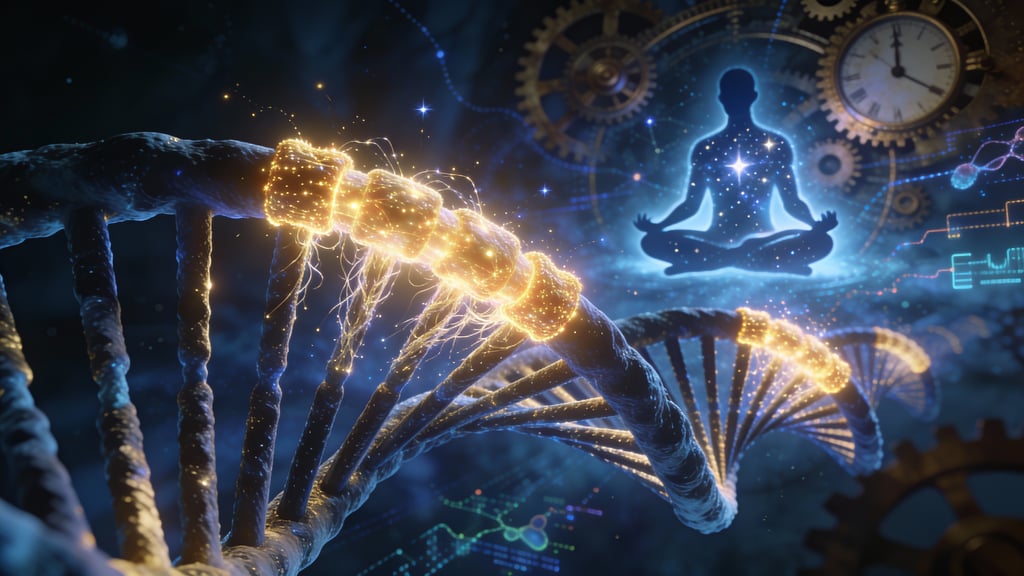
Every cell in your body carries a biological clock. Not a metaphorical one. A literal countdown timer. This clock lives at the ends of your chromosomes in structures called telomeres. And understanding how they work opens up something profound: a real understanding of why we age and, potentially, how to slow that process way down.
Telomerase: The Enzyme of Life Extension
Meet telomerase. This enzyme is essentially the key to cellular immortality. It's the biological fountain of youth that scientists have been chasing for centuries, and it turns out it's been inside us all along.
What makes telomerase so remarkable is its ability to add length back to shortened telomeres. Think about that for a second. It can literally reverse cellular aging at the molecular level.
Here's the mechanics: telomerase contains both protein and RNA components that work together to extend telomeres by adding repetitive DNA sequences (TTAGGG) to chromosome ends. This matters enormously because it keeps our genetic material stable and intact. When telomeres get too short, our DNA becomes vulnerable to damage. That's when we start seeing all those age-related diseases and conditions we've been taught to accept as inevitable.
Here's where it gets interesting. Telomerase is highly active in some cells but practically nonexistent in others. Embryonic cells? Loaded with telomerase, which lets them divide rapidly without their telomeres shrinking. Certain stem cells, activated immune cells, and (unfortunately) cancer cells also maintain telomerase activity. That's why they can keep dividing indefinitely.
But most of your adult somatic cells (the ones making up your organs and tissues)? Their telomerase expression gets shut down right after birth. So with every cell division, telomeres get progressively shorter until they hit a critical length called the Hayflick limit. At that point, cells stop dividing and enter senescence. This cellular aging is what drives the aging of your entire body.
DNA End Caps: Protecting Your Blueprint
Think of telomeres like those little plastic tips on shoelaces. You know the ones. Just as those tips prevent your laces from fraying into an unusable mess, telomeres protect your chromosomes from deteriorating. Without them, your genetic information would become scrambled and unreadable.
Every time a cell divides, there's a problem. The cellular machinery that copies DNA can't fully replicate the very ends of chromosomes. Scientists call this the "end-replication problem," and it means that with each division, telomeres get a little bit shorter. The cell tolerates this for a while, but eventually those telomeres become so short they can no longer do their job. The cell recognizes the critically short telomere as damaged DNA and refuses to divide anymore.
So, telomere shortening functions as a cellular aging clock, counting down the number of times a cell can replicate. In humans, most cells get roughly 50 to 70 divisions before hitting this wall. Leonard Hayflick discovered this phenomenon back in the 1960s, and it's been reshaping our understanding of aging ever since.
The implications here are huge. As your cells reach their replicative limit, your tissues lose their ability to regenerate effectively. Your skin loses its elasticity. Your organs decline. Your immune system weakens. This is what we call "aging." But what if we could slow this process down, stop it, or even reverse it?
Recent research shows exactly that possibility. Scientists have successfully activated telomerase in adult cells, causing telomeres to lengthen and cells to regain their youthful capacity for division. In one groundbreaking study, researchers added just three applications of modified telomerase-encoding RNA to human cells. The result? More than a 10% increase in telomere length. Those cells then divided approximately 28 more times than untreated cells.
Ancient Wisdom Meets Modern Science
Here's where things get fascinating. The discovery that human cells have this capacity for extreme longevity validates something ancient spiritual traditions have been teaching for thousands of years. Yogic texts describe advanced practitioners living for centuries, even millennia, through mastery of the body's subtle energy systems. Chinese Taoist practices aimed at immortality describe techniques for activating the body's intrinsic healing and regeneration mechanisms.
Were these traditions just speaking in metaphors? Or did ancient sages understand biological processes that modern science is only now catching up to? The evidence increasingly points toward the latter. Practices like meditation, breathwork, fasting, and sexual energy retention (all emphasized in traditional longevity systems) have been shown in modern research to influence telomerase activity and telomere length.
Certain natural compounds have been identified as potent telomerase activators. TA-65, derived from the Chinese herb Astragalus membranaceus, has been shown in clinical trials to lengthen telomeres in humans. Other plant-derived compounds like cycloastragenol show similar effects. These are the same herbs that traditional Chinese medicine has used for centuries to promote longevity and vitality.
The synthesis of ancient wisdom and modern science reveals something profound: the potential for radical life extension already exists within you. Your DNA contains the code for extreme longevity; it just needs to be activated. The question isn't whether such activation is possible (science has proven it is) but how to achieve it safely and effectively.
What You Can Actually Do About It
Lifestyle factors play a crucial role here. Chronic stress accelerates telomere shortening, while stress-reduction practices like meditation preserve telomere length. Diet quality affects telomere maintenance, with nutrient-dense, anti-inflammatory foods supporting cellular health. Exercise has been shown to activate telomerase and preserve telomeres. Sexual energy conservation, emphasized in many spiritual traditions, may preserve vital essence that would otherwise be depleted through frequent ejaculation.
The implications extend far beyond individual longevity. If humanity could activate telomerase safely and broadly, we could eliminate most age-related diseases, extend productive lifespans dramatically, and create a civilization where wisdom accumulated over centuries could be applied to solving our most pressing challenges. Imagine not having each generation relearn lessons the previous one forgot.
Where Theory Meets Reality
Now, let's get honest about what we're actually dealing with here. The claim of a 20,000-year lifespan is grounded in valid theoretical physics and statistical modeling, but it remains, for now, a biological aspiration rather than a clinical reality.
When researchers like Dr. João Pedro de Magalhães speak of living 20,000 years, they're not suggesting we have a pill ready to make it happen. They're calculating a statistical probability: if we could completely halt biological aging (the internal degradation of cells), the only things left to kill us would be external accidents. Car crashes. Infections. Falling pianos. Based on current accident rates, the average human would survive roughly 20,000 years before a fatal event occurred.
So where does the science actually stand between "theoretical potential" and "practical application"?
The "Software" Theory of Aging
The most credible part of this research is the fundamental shift in how we view aging itself. We used to think of aging as "wear and tear," like a tire losing tread. Now, top biogerontologists increasingly view it as a software problem: a glitch in the epigenetic code that tells genes when to switch on and off.
The reliability here is high. We know reprogramming is possible. Scientists have successfully taken old skin cells and reset them to an embryonic state (iPS cells), proving that the "age" of a cell is reversible, not fixed. This isn't speculation. It's been demonstrated in labs around the world.
The Telomere Connection (A Nuanced View)
While telomeres are undeniably linked to cellular health, the idea that simply lengthening them equals immortality is an oversimplification. Short telomeres correlate with higher mortality and disease risk, but they're not the only predictor of how long you'll live.
Some studies show that telomere length alone is less predictive of death than simple factors like your chronological age. Telomeres are one vital piece of a much larger puzzle involving mitochondrial health, protein cleanup, inflammation, and a dozen other factors we're still mapping out.
This doesn't diminish the importance of telomeres. It just means we need to approach longevity as a systems problem, not a single-variable solution.
The Cancer Paradox (The Major Hurdle)
This is the "Great Filter" of longevity research. The same enzyme (telomerase) that restores youth to healthy cells is also the fuel that cancer cells use to grow indefinitely.
Here's the reality: to live 20,000 years, we'd need to solve a biological catch-22. We need to activate cellular repair mechanisms powerful enough to stop aging, but controlled enough to prevent tumors. Nature balances this trade-off by shutting down telomerase in adults; turning it back on requires a level of precision we're still learning to master.
Recent research has developed methods for transient telomerase activation that extend cellular lifespan without creating cancer risk. We're getting closer. But "closer" and "there" are different things.
The Question of Access
The knowledge exists. The technology is being developed. What remains is the question of access. Will this information be made available to everyone, or will it be hoarded by elites who wish to extend their own lives while keeping the rest of us in the dark?
This is one more reason why awakening (both spiritual and intellectual) matters so urgently. The secrets to longevity should belong to all of us.
The Perspective
The 20,000-year figure is a lighthouse, not a map. It shows us how far the journey could go, proving that death by aging is not a biological necessity but a technical challenge.
It is my personal belief that once we reach a stage of total awareness and control over our body and functions, we should be able to activate this ability at will. Without the cancer implications.
with Boundless Love,
Devin