
The Space Between Thoughts
The Words That Change When You Do
EPISODE 4
12/9/20255 min read
A Blog Post That Reads You While You Read It
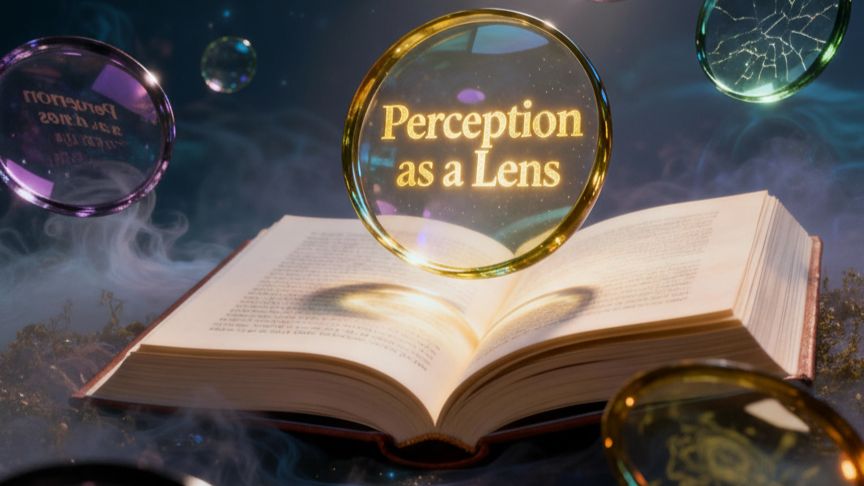
Before you begin: This piece is an experiment in perception. The words below don't change, but what you see in them will. Your current emotional state acts as a lens, filtering meaning through your particular frequency. Read it three times from three different states of mind, and you'll encounter three different teachings.
Choose Your Lens (or let it choose you):
If you're stressed, skeptical, or resistant → You'll find permission to question everything and practical reasons why this matters
If you're curious and open → You'll discover invitations to explore and experiment with your own awareness
If you're contemplative or meditative → You'll encounter deeper layers about consciousness itself
The text remains identical. Your interpretation reveals where you are.
The Space Between Thoughts
There's a pause that lives between your thoughts. You've never noticed it because you've never stopped looking for the next thought long enough to see it. This pause isn't empty. It's full of everything that thinking interrupts.
Most people treat silence like a problem that needs solving. The moment one thought ends, panic sets in, and the mind immediately generates another. It's exhausting, this constant production. But it's also optional.
That space between thoughts? It's not a gap in your experience. It's the ground your experience rests on. Everything you've ever thought, felt, or perceived emerged from it and returns to it. You are not your thoughts any more than the ocean is its waves. The waves come and go. The ocean remains.
This isn't philosophy. It's immediate and verifiable. Right now, as you read this, thoughts are appearing in awareness. But awareness itself isn't thinking. It's witnessing. It's the still point around which everything moves.
When you stop trying to control your mind and simply watch it instead, something shifts. The thoughts keep coming, but they no longer hijack you. You become the space they move through rather than the passenger they carry away. This isn't about achieving perfect stillness or emptying the mind. It's about recognizing what you already are beneath the noise.
The untrained mind mistakes thinking for consciousness. It believes it IS the voice in the head. But you can observe that voice, which means you can't be it. Whatever can be observed is not the observer. This is the crack in the illusion, the place where awakening begins.
You don't need special circumstances or years of practice to access this. You need only to stop, look, and see what's already here. The space between thoughts is always present. You just haven't been trained to value it. You've been taught to fill it, to fear it, to talk over it with more thinking.
But here's what happens when you don't: You discover that silence has texture. Presence has qualities. Awareness itself is not blank or passive. It's alive, intelligent, saturated with something you can't name but can definitely feel. Some call it peace. Others call it being. The name doesn't matter. What matters is that it's always been here, underneath the mental weather, waiting for you to notice.
The mind is a tool, not a tyrant. When you see it clearly, you stop believing every story it tells. You use thought when it serves you and release it when it doesn't. The constant internal commentary becomes background noise rather than the soundtrack of your life.
This shift doesn't happen through effort. It happens through attention. You simply begin noticing the space more often than the thoughts. At first for a second, then for a breath, then for longer. The space grows not because you're creating it, but because you're finally acknowledging it was always there.
And here's the thing nobody tells you: The space changes you. Not dramatically, not overnight, but steadily. The more you rest in awareness itself rather than in the contents of awareness, the less seriously you take your own mental drama. Problems don't disappear, but they lose their grip. Fear still arises, but you're no longer consumed by it. You become less reactive, less defended, more present to what actually is rather than what you think should be.
This is what meditation is actually for. Not to achieve some special state, not to become a different person, but to recognize what you already are when you stop pretending to be your thoughts. The you that's aware of thinking is deeper than any thought. The you that notices emotions is untouched by any emotion. The you that observes experience is never damaged by experience.
You don't need to believe this. You can test it right now. Pause. Notice that you're aware. Notice that awareness itself doesn't come and go like thoughts do. It's the constant backdrop, the unchanging witness, the space in which this entire life unfolds.
That's it. That's the whole teaching. Everything else is just different ways of pointing at the same moon.
What Did You Find?
If you were stressed or skeptical: You found evidence that you're not crazy for questioning your relationship with your mind. You saw practical reasons why noticing the space between thoughts might reduce anxiety and improve mental clarity. You encountered permission to challenge the assumption that constant thinking equals consciousness.
If you were curious and open: You found invitations to experiment with your own awareness. Prompts to pause and check your direct experience. Suggestions that you could verify these claims immediately without needing special training or circumstances.
If you were contemplative: You found pointers to the nature of consciousness itself. Recognition that awareness precedes thought. The understanding that what you fundamentally are cannot be damaged by what you experience. The teaching that meditation isn't about achieving states but recognizing what already is.
Same words. Different doors.
Your mood didn't change the text. It changed what you could see in the text. This is how perception works in every moment of your life, not just while reading. Your emotional state acts as a filter, highlighting certain frequencies while dampening others. When you're angry, you see threats. When you're grateful, you see gifts. When you're afraid, you see danger.
The world doesn't change. Your lens does.
And here's the liberating part: Once you know you're wearing a lens, you can take it off and look at it. You can recognize that what you're seeing is being shaped by what you're feeling. You become less convinced by your own interpretations because you see them for what they are: interpretations, not facts.
The space between thoughts is where you learn this. It's where you realize that consciousness itself is the only constant. Everything else, thoughts, emotions, states of mind, they're all weather patterns moving through the sky of awareness.
You are the sky, not the weather.
That's worth noticing.
P.S. If you're wondering which interpretation is "correct," you've missed the point. They're all correct. They're all incomplete. The map is never the territory, and any description of consciousness is necessarily a reduction of it. The only way to know what this points to is to look directly at your own experience and see what's true for yourself.
That's the difference between knowledge and wisdom. Knowledge is borrowed. Wisdom is recognized.
Connect
Join our journey toward deeper awareness.
Contact
© 2025. All rights reserved.